The Dealer Scorecard Is Backwards
- Brandon Bonham
- Jun 2
- 6 min read

Not long ago, a major equipment manufacturer announced it was redrawing its sales territories. More reps. Smaller regions. Fewer dealers per territory. The stated goal, right there in the announcement, was to strengthen communication with the dealer network and improve dealer satisfaction.
It's a good move. I mean that. Putting more people closer to the dealers is almost always better than the alternative.
But read the announcement again and you notice something. Every action in it is something the manufacturer is doing to the network. More reps to call on dealers. Tighter territories to manage dealers. Better communication with dealers. The dealer is the object of every sentence. Never the subject.
That's not a criticism of one company. It's the water the entire industry swims in. And it shows up most clearly in the one document every dealer principal in America has sitting in a drawer: the dealer scorecard.
Why Dealer Scorecards Feel Like a List of Costs
You know the scorecard. Maybe it's called a dealer standards agreement, a partnership program, a tier qualification. The name changes. The contents don't.
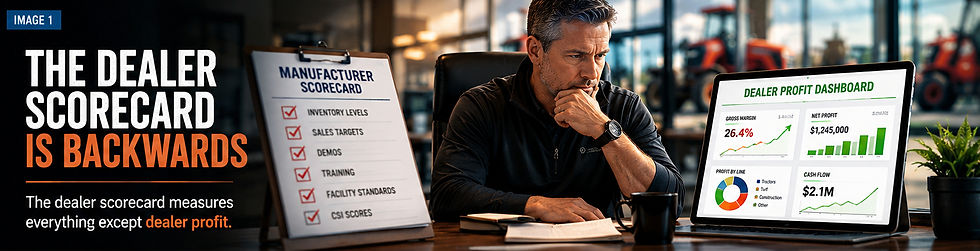
Inventory levels — carry this much, in this mix. Sales targets — move this many units. Demonstrations — log this many. Training — send your people to these sessions. Facility standards — paint, signage, showroom footprint. Customer satisfaction — keep your buyers happy enough to fill out the survey and score you well.
Now look at that list the way a dealer looks at it. Every single line is something the manufacturer wants. And almost every line carries a cost. Inventory is capital tied up on the lot. Training is payroll plus travel plus a tech off the floor for a day. Demos are units that aren't generating revenue. Facility standards are a check written to a contractor.
The scorecard is a list of asks, and every ask has a price tag attached. That is how it reads from the dealer's side of the desk. I know, because I sat on that side of the desk for twenty-five years.
Dealers aren't difficult. They're rational.
Here's what manufacturers consistently misread. When a dealer drags their feet on the scorecard, the manufacturer's instinct is that the dealer is being difficult. Short-sighted. Hard to work with.
The dealer isn't being difficult. The dealer is being a businessman.
Any profitable enterprise does two things by reflex: maximize revenue, minimize cost. That's not a character flaw — that's the definition of running a business well. So when you hand a dealer a list of things that all cost money and ask them to do more of each, you should expect resistance. You've handed them a list of costs and asked them to volunteer for more of them.
And here's the irony: the well-run dealerships — the exact ones you most want in compliance — are the ones whose discipline around cost makes them push back the hardest. You're not fighting your worst dealers on the scorecard. You're fighting your best ones.
The resistance isn't a relationship problem. It's a math problem. And you can't fix a math problem with more reps, a friendlier territory map, or another email about partnership.
How Reframing the Scorecard Around Dealer Profitability Changes the Game
Look at the scorecard one more time and ask a different question. Where on this document does it measure whether the dealer actually makes money selling your product?
It doesn't.
The scorecard measures compliance. Units, inventory, demos, training, facilities, satisfaction. It measures everything except the one number that drives a dealer's behavior every single day: margin. Gross profit by line. What the dealer keeps after the unit rolls off the lot.
That omission is the whole ballgame. Because the dealer is already running that number in their head, whether you put it on the scorecard or not. Every morning, a dealer principal is making quiet decisions about which lines get the floor space, which lines get the salespeople's attention, which lines get the marketing dollars. Those decisions are made on margin. Always have been.
So there are two documents in the room. The manufacturer's scorecard, which measures compliance. And the dealer's mental ledger, which measures profit. They are not the same document — and most of the time, they're not even pointed in the same direction.

The thing most dealers don't actually know
Here's where it gets interesting, and where the real opportunity lives.
Most dealers carry multiple lines. A tractor brand, a turf brand, a construction line, maybe a golf car line tagging along. And most dealers could not tell you, with any precision, which of those lines carries the highest gross margin. They have a gut feel. The gut feel is frequently wrong.
I'll go further. In a lot of dealerships, the line the manufacturer is fighting hardest to get attention for is quietly the most profitable line on the floor — and nobody in the building knows it, because nobody has ever laid the margins side by side.
Sit with what that means. The manufacturer is treating the relationship as a negotiation — pushing the dealer to carry more, sell more, train more — while sitting on the single most persuasive fact in the entire conversation: you make more money per unit on us than on the brand you're prioritizing. And they're not using it. They're not using it because they don't know it either. The data lives in the dealer's accounting system, and nobody on either side has bothered to put it on the table.
From adversary to partner
This is the shift. It's subtle, and it changes everything.
Stop opening with what you want. Open with what they make.
The first question a manufacturer's rep should be able to answer isn't "did this dealer hit their demo quota." It's "is this dealer making money on our line — and do they know it?" When you can show a dealer, with real numbers, their numbers, that your line is among the most profitable products they sell, every item on that scorecard transforms.
Carrying more inventory isn't a cost anymore. It's stocking your best-margin product. Sending techs to training isn't payroll burn. It's protecting the profitability of your most profitable line. Demos aren't lost revenue. They're how you sell more of the thing that makes you the most money.
You haven't changed a single item on the scorecard. You've changed what the scorecard is. It went from a list of the manufacturer's demands to a roadmap for the dealer's own profit. Same actions. Opposite meaning.
And now the relationship is different. You're not an adversary asking for concessions. You're a partner who showed up with a fact the dealer didn't have and used it to make them money. That is the relationship where you finally earn the right to ask for a lot — because you've proven that what you ask for and what makes the dealer money are the same thing.

What this actually asks of manufacturers
None of this is soft, and none of it is easy. It's harder than the current approach, not easier.
It means a manufacturer has to genuinely understand dealer economics — not just their own wholesale margins, but what the dealer keeps, line by line, against everything else on the floor. It means benchmarking dealer profitability across the network, so you can show a dealer not only their own margins but where they sit against their peers. It means retraining a sales force that has spent its entire career carrying a list of asks to instead carry a profit-and-loss conversation.
That's a real shift. It doesn't happen with a new scorecard template or a slide at the annual meeting.
But the manufacturers who make it stop fighting their own dealers. They stop mistaking rational cost discipline for resistance. And they start having the only conversation that has ever actually moved a dealer — the one about the money the dealer is, or isn't, making.
The scorecard isn't wrong because it asks too much. It's wrong because it's pointed in the wrong direction. Flip it around. Lead with the dealer's profit, and you'll find the asks take care of themselves.
Brandon Bonham spent 25+ years operating an equipment distributorship, scaling it from one location to eight across five states. He's a CPA with Big Four training and an active YPO forum member and moderator. He works with dealers and manufacturers across the golf car, tractor, turf, and construction equipment industries. Brandon@BrandonBonham.com · 801-633-2590 · www.BrandonBonham.com


Comments